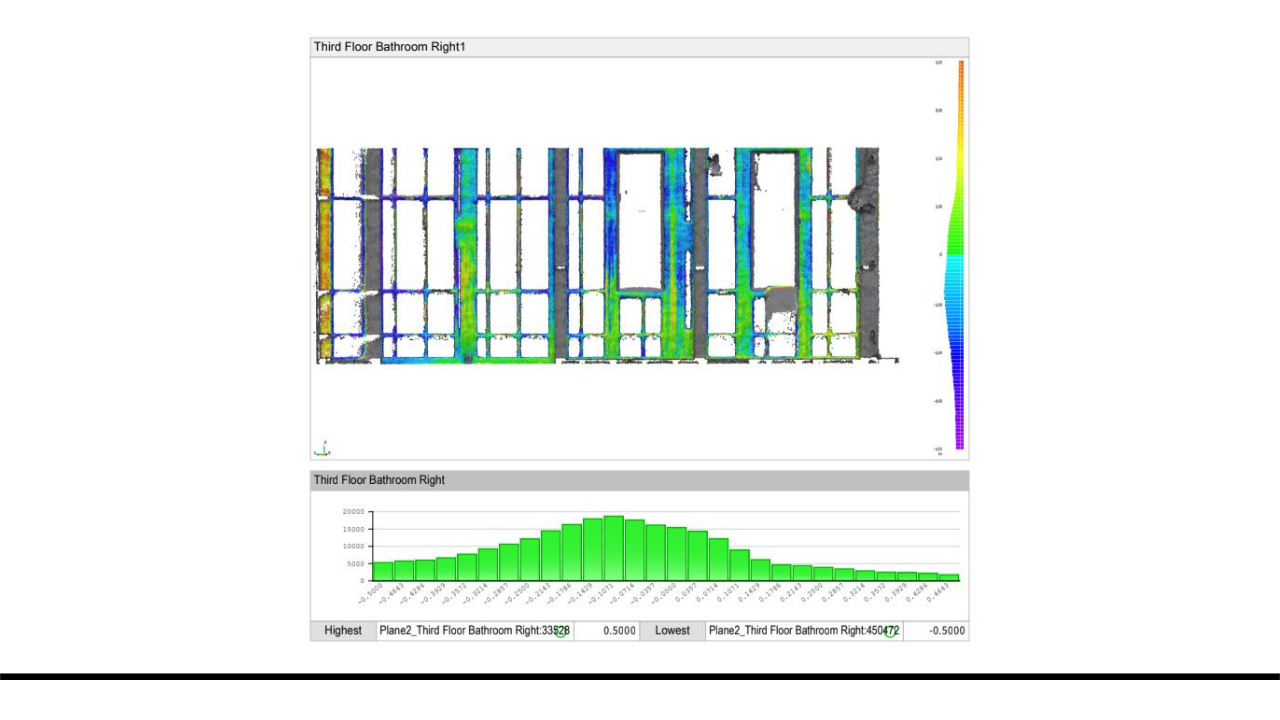
Once the drywall goes up, the framing is buried. We scan the wall while the studs are still open and map every one that sits proud or bowed off the plane. You see which studs are out and by how much against the 1/8 inch line, and you get a permanent record of the framing and rough-in before it disappears behind the board.
The framed wall is scanned and compared to a true plane. Color shows which studs push proud and which sit back, and the histogram shows how the whole wall is distributed. The proud stud that would have telegraphed through the finish is visible now, while it is a five minute fix.
A stud deviation map built from a laser scan of open framing, with a distribution of how far the wall varies from plane.
Why scan the framing before the drywall?
A slight bow that is acceptable to a framer is a catastrophic imperfection to a drywall contractor, because it creates a wavy wall that is impossible to hide. Drywall waviness is one of the most common callbacks in the trade, and by the time it shows up the framing is already covered.
The plane and alignment of the panels depend on the plane and alignment of the studs. Catch a proud stud during framing and the fix is a plane or a shim. Catch it after paint, tile, and cabinets are in, and a quarter inch of framing error turns into thousands of dollars of rework. A scan is the x-ray that finds it while it is cheap.
How flat does the framing have to be?
GA-216 and ASTM C840 set the line the drywall industry works to: the attachment surfaces of framing members shall not vary more than 1/8 inch from the plane of the faces of adjacent members. Finish quality wants flatness and plumb within 1/8 inch over 10 feet.
That plane is where the trouble hides. A stud that is out by a quarter inch reads fine to the framer and pushes the board out enough to telegraph a wave the painter cannot bury. The finish trades inherit whatever the framer leaves, so a bad plane cascades into tile lippage, cabinets that will not mount flush, and doors that will not hang. The heat map measures every stud against the 1/8 inch line and flags the ones that miss.
Who needs the framing on record?
Builders and framers
Custom and high-end builders already market scanning before the drywall as a differentiator. The scan catches the out-of-plane stud before it becomes a warranty call, and it documents the framing for the appraisal and the owner years later.
Drywall subs
A scan documents the substrate you were handed. When a wavy wall comes back on you, the map shows the framing was out of tolerance before you hung a sheet. That is a record that protects the callback from landing on the wrong trade.
QC, owners, and warranty
Third-party QC and owner's reps verify tolerance at the hold point before walls are closed. Insurers and warranty programs get a dated deviation record of exactly what was built. Construction defect claims run on evidence, and this is evidence.
What the deliverable includes.
Deviation heat map
The framed wall in color against a true plane. Proud studs push one way, studs that sit back push the other, aligned framing reads clean.
Per-stud flags
A list of which studs are out and by how much against the 1/8 inch line, so the fix is targeted instead of a guess down the whole wall.
A permanent record
A dated point cloud of the framing and the rough-in behind it, kept for warranties, appraisals, and anything that has to be found behind the wall later.
Published prices.
Deliverable
Price
Half-day scan (capture)
$1,500 to $2,300 to start
Full-day scan (capture)
$3,500 to $4,100 to start
Modeling from the scan
$0.10 / sq ft ($500 min)
Capture is the scan itself. The framing analysis is scoped to the walls, the tolerance, and the reporting you need, so we quote the report directly once we know the job. Tell us the wall count and the finish you are protecting and we price it. Timing matters here, since the window closes when the drywall goes up.
Send us the walls and the drywall date. We scan the open framing, map every stud against the plane, flag the ones that miss, and hand you a record you can act on now and keep for good.